Fringe
and The Harvard Psychedelic Club
On
one level, the FOX drama Fringe is an intricately crafted sci-fi
adventure about two worlds, one of our own and an alternative reality,
that find themselves at war with each other but soon discover that the
only means for survival is to work together in harmony. It is also,
however, the story of main characters Olivia Dunham, Walter Bishop and
Peter Bishop as they come to terms with the events of their past while
finding both redemption and the human bonds necessary to make their
way through life in the process. Thus within the framework of Fringe,
the past is just as much as important as the present, and in many ways
it is the prologue of Walter Bishop that serves as the catalyst for
the narrative.
During
the 1970s, Bishop was a brilliant scientist who conducted cutting-edge
experiments for the government within his laboratory at Harvard University.
Walter Bishop had an equally brilliant partner in William Bell, and
the two conducted research in the field of fringe science that often
defied the laws of physics. In the series of short video introductions
to Fringe that premiered on ABC.com shortly before the launch
of the show’s fourth season, narrator John Noble comments that
“Bishop and Bell were once the Lennon and McCartney of science,
lab partners intent on pushing the boundaries and blurring the perceptions
of reality.”
Other comparisons
could likewise be made, including to that of Apple founders Steve Jobs
and Steve Wozniak. Just as many of the scientific breakthroughs came
at the hands of Walter Bishop, for instance, it was Wozniak who developed
the initial personal computer that established the company in the 1970s.
Yet it was both William Bell and Steve Jobs that ultimately had the
charisma and internal drive to transform both the fictional Massive
Dynamic of Fringe and Apple Inc. of reality into the dominant
corporate forces into which they eventually evolved.
READ
MORE

'Fringe
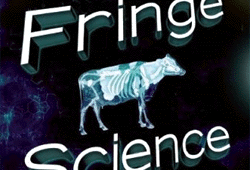
Science' Explores the Sci-Fi Drama Fringe
 “You’re
telling me what?” Peter Bishop asks in the pilot episode of the
FOX drama Fringe. “My father was Dr. Frankenstein?”
“You’re
telling me what?” Peter Bishop asks in the pilot episode of the
FOX drama Fringe. “My father was Dr. Frankenstein?”
The Mary
Shelley classic novel of scientific ambition taken beyond ethical or
moralistic boundaries may not necessarily be the first sci-fi narrative
one considers upon viewing Fringe. With its basic premise of
a small-team of FBI agents tasked to investigate strange and deadly
occurrences, that role is initially filled by another FOX series, The
X-Files. The cases investigated by the Fringe Division, however,
do not fall into the category of the supernatural but science taken
to theoretical extremes, making the show a true incantation of the science
fiction genre. In the anthology volume Fringe Science: Parallel
Universes, White Tulips, and Mad Scientists (BenBella Books, 2011),
a number of physic professors, sci-fi historians and television connoisseurs
offer their own interpretations on Fringe—and not one
of them shines the spotlight solely upon Fox Mulder and Dana Scully.
At least
three of the essays contained in Fringe Science trace the roots
of the television series far deeper and broader within the works of
science fiction than any more contemporary sources. Mary Shelley’s
Frankenstein is often considered the birth mother of the genre,
and in “In Search of Fringe’s Literary Ancestors”
author Amy H. Sturgis begins her study of the FOX drama with the “modern
Prometheus” of old. According to Fringe co-creator J.J.
Abrams, the similarities between Dr. Victor Frankenstein and Dr. Walter
Bishop are intentional as the idea of a genius scientist ignoring conventions
and pressing further with his experiments regardless of the consequences
played a key factor in the creation of Fringe. More significantly,
the primary driving force for the reckless behavior of both Victor and
Walter is the death of someone beloved in their life—for Dr. Frankenstein,
it was his mother and in the case of Dr. Bishop, his son Peter.
READ
MORE
Fringe
and the Physics of the Impossible
 The
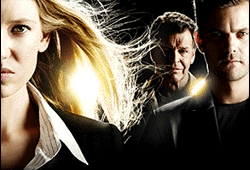
world in which the FOX drama Fringe takes place is one filled
with scientific wonder. The elderly Dr. Walter Bishop spent the better
part of the 1970s and 80s pushing the boundaries of modern physics and
turning previously inconceivable notions into successful conclusions.
From teleportation to mind control to genetic mutation to proving the
existence of a parallel universe, nothing was too far on the “fringes”
of present-day science for Dr. Bishop to tackle and thrive. He was in
essence a combination of Albert Einstein and Victor Frankenstein, brilliant
and unbound by convention while likewise oblivious to the potential
consequences of his work.
The
world in which the FOX drama Fringe takes place is one filled
with scientific wonder. The elderly Dr. Walter Bishop spent the better
part of the 1970s and 80s pushing the boundaries of modern physics and
turning previously inconceivable notions into successful conclusions.
From teleportation to mind control to genetic mutation to proving the
existence of a parallel universe, nothing was too far on the “fringes”
of present-day science for Dr. Bishop to tackle and thrive. He was in
essence a combination of Albert Einstein and Victor Frankenstein, brilliant
and unbound by convention while likewise oblivious to the potential
consequences of his work.
Of course
the world in which Fringe takes place is one of science fiction,
not reality, but like all good science fiction, the roots of its science
lie within reality nonetheless. H.G. Wells, for instance, wrote The
First Men in the Moon close to seventy years before Neil Armstrong
and Buzz Aldrin literally became the first men to step foot there. The
1960s series Star Trek, meanwhile, has served as the catalyst
for many scientific achievements since its initial broadcast on NBC,
and even inspired an entire generation of physics and engineering professionals
in regards to their career choice.
Acclaimed
scientist Michio Kaku, meanwhile, became fascinated by scientific possibilities
as a youth watching reruns of Flash Gordon. In 1968, he graduated
summa cum laud from Harvard University and received his Ph.D. from the
University of California, Berkley, four years later. Kaku has since
published over 170 academic articles on everything from superstring
theory to supersymmetry, and is considered to be one of the most distinguished
physicists of his time. Despite such professional achievements, however,
Kaku still has a common man fascination with science fiction and has
written a number of books exploring the possibilities found within the
narratives of television shows like Star Trek. Although published
the same year that Fringe premiered on FOX, Physics of
the Impossible (Doubleday, 2008) explores many of the scientific
accomplishments of Dr. Walter Bishop nonetheless and places them in
a modern day context of limitless possibilities.
READ
MORE

