
Justified and Dirty Harry
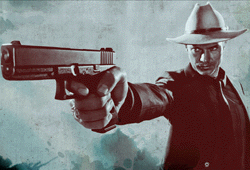
In many respects, Dirty Harry and Raylan Givens are as much polar opposites as the cities in which they patrol. Givens, for instance, is a sharply dressed US Deputy Marshal with a penchant for cowboy hats and boots to compliment his attire. As a homicide detective for the San Francisco Police Department, Callahan prefers the traditional dress pants, tie and suit jacket of his profession. While each law enforcement official is prone to utter sharp quips in the direction of their prey, Dirty Harry recites his lines in a gruff, no-nonsense style while Raylan Givens is more openly charismatic in his delivery. Callahan, meanwhile, is more intense and tightly wound than his Kentucky counterpart, who displays a much more laidback demeanor. Despite such differences, however, these two cultural icons ultimately have more in common as they keep the streets and hollers of their respective communities safe from murderers, thugs and drug dealers.
Harry Callahan made his debut in the 1971 film Dirty Harry. At that time, law enforcement was reeling from various Supreme Court cases that granted previously unseen rights to the criminal element—the 1964 ruling in Escobedo v. Illinois entitled a suspect to have an attorney present during police questioning, while Miranda v. Arizona in 1966 instituted a “reading of the rights” procedure for arrests. There was thus a fear in both police departments and communities that the results of these rulings would usher in a period of lawlessness in the United States. Harry Callahan of the San Francisco Police Department had no intentions of being constrained by such regulations, however, and carried out his own set of ideals in regards to apprehending a suspect.
“Where the hell does it say that you’ve got a right to kick down doors, torture suspects, deny medical attention and legal counsel?” the district attorney in Dirty Harry asks Callahan. “Where have you been? Does Escobedo ring a bell? Miranda? I mean, you must have heard of the Fourth Amendment.”
Although Raylan Givens appeared on the small screen close to forty years later with the premier of Justified in 2010, he immediately exhibits the same disregard for conventional regulations as he confronts a gun thug for a Miami drug cartel in the pilot episode of the series. After giving Tommy Bucks twenty-four hours to leave town or face retribution, Givens kills his prey under the pretext that the suspect drew first when the allotted time had expired. “You do know that we’re not allowed to shoot people on sight anymore?” he is asked afterwards. “And haven’t been for, I don’t know, maybe a hundred years.”
For his transgression, Deputy Marshal Givens is transferred to the hills of Eastern Kentucky where he grew up. It is also a region filled with its own form of lawlessness as various criminal elements have divided the area into private fiefdoms centering on extortion, marijuana growing and drug trafficking. Just as the San Francisco Police Department was hampered in the Dirty Harry films to bring suspects to justice, the same holds true for traditional law enforcement in Harlan County on Justified. It thus falls upon Raylan Givens and his throwback style of vigilante law enforcement to keep the peace, much as it was for Harry Callahan in the 1970s.
The tactics of both Harry Callahan and Raylan Givens are sources of frustration for their superiors. “I got nothing personal against you, but we can’t have the public crying police brutality every time you go out on the street,” Callahan is told during the second film in the Dirty Harry series, Magnum Force. “Every time you pull out that gun, my paperwork backs up for three months,” another police director later adds. Givens, meanwhile, is a continual thorn in the side of his direct supervisor Art Mullen. When asked if he wants to transfer Givens, Mullen replies, “Honestly, Raylan, I don’t know who would take you.”
While additional paperwork on the part of the department does not deter Harry Callahan, it does have an effect on Raylan Givens when that paperwork falls on his own shoulders. “Normally I would have just shot you myself the second you pulled,” he explains on Justified during the season two premier. “But I am doing my level best to avoid the paperwork and the self-recrimination that comes with it.”
In addition to a penchant for utilizing their weapons when faced with the criminal element, Harry Callahan and Raylan Givens do not suffer fools lightly and demonstrate a lack of patience when faced with situations that could be more readily resolved. In the original Dirty Harry, for instance, Callahan stumbles upon an attempted suicide and is persuaded to “talk the man down” from the ledge that he is threatening to jump. Rather than offer soothing words of comfort, however, Harry Callahan decides to take a different approach.
“I’d just like your name and address, that’s all,” he tells the man. “It’s such a mess down there afterwards. Makes identification impossible, even if they find your driver’s license. All that blood and everything.”
In the episode of Justified entitled “Blaze of Glory,” Raylan Givens finds himself in the midst of a bank robbery attempt and likewise displays a disregard for the conventional method of resolving such a conflict. He confronts the two culprits despite the risk to innocent bystanders, for instance, and is undeterred when one of them reveals explosives tied to their waste. “You know where I’m from?” he asks. “Harlan County. Down there, we know the difference between dynamite and road flares.” Givens then subdues the would-be robber with his fist rather than firearm.
Harry Callahan and Raylan Givens may be polar opposites in regards to their personal attire and background, but both of these fictitious characters understand that the surroundings and culture of their times are in need of a different form of justice. Faced with the criminal element, they react in much the same way—with a “whatever it takes” attitude to prevent future crimes from occurring and keep their respective cities safe for every day citizens. Dirty Harry Callahan and US Deputy Marshal Raylan Givens are also pop culture icons of the big and small screens that entertain their audiences with a vision of law enforcement that might not be acceptable in the real world but is yearned for nonetheless.
While both men are often short on words, Harry Callahan and Raylan Givens also display a sharp wit when faced with using language as opposed to guns. The most famous example stems from the original Dirty Harry when Callahan has a suspect cornered with their gun just out of reach. “I know what you’re thinking,” Harry Callahan softly recites. “‘Did he fire six shots or five?’ Well, to tell you the truth, in all this excitement I kind of lost track myself. But being as this is a Forty-Four Magnum, the most powerful handgun in the world, and would blow your head clean off, you’ve got to ask yourself a question—‘Do I feel lucky?’ Well, do ya, punk?”
In a short commercial for Justified that aired during Super Bowl XLV, meanwhile, Raylan Givens has his own suspect at gunpoint. “This situation feels very familiar,” he begins. “In fact, I know what you’re thinking. ‘Did he fire seventeen shots or sixteen?’ Think I may have lost track myself. So I suppose there’s only one question you should be asking yourself.”
“Do I feel lucky?” the suspect replies, at which point Givens sucker punches him in the face. “Why wasn’t I watching the other hand?” he then offers as the correct response.
It may not be as catchy as the original soliloquy of Dirty Harry, but is equally effective nonetheless.
Anthony Letizia (February 8, 2012)
Discuss on the alterna-tv.com Forum
