Justified
Contains the Modern Swagger of an Old Western
 Most
crime dramas tend to gravitate to the big city for their setting. There
are CSIs, for instance, operating in Las Vegas, Miami and New
York. Even the more character-driven shows that have sprung up on cable
channels in the early days of the Twenty-First Century utilize the likes
of Miami (Burn Notice), Boston (Leverage) and New
York City (White Collar) for their backdrops. The FX series
Justified, meanwhile, is set in the unorthodox locale of Lexington,
Kentucky, and a small community on the outskirts known as Harlan County.
Most
crime dramas tend to gravitate to the big city for their setting. There
are CSIs, for instance, operating in Las Vegas, Miami and New
York. Even the more character-driven shows that have sprung up on cable
channels in the early days of the Twenty-First Century utilize the likes
of Miami (Burn Notice), Boston (Leverage) and New
York City (White Collar) for their backdrops. The FX series
Justified, meanwhile, is set in the unorthodox locale of Lexington,
Kentucky, and a small community on the outskirts known as Harlan County.
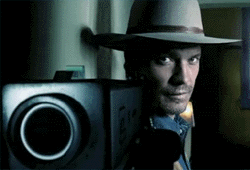
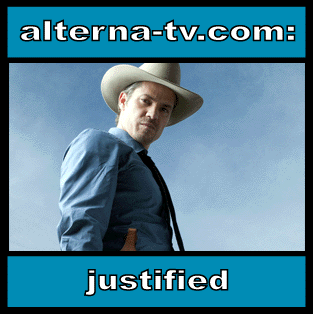
US Deputy
Marshal Raylan Givens (Timothy Olyphant) left Harlan at a young age
but the cultural influences of his youth run through his DNA no matter
how hard he has tried to escape his roots. Givens outfits himself with
cowboy boots and hat as well as a gun prominently holstered around his
waist. Despite personal charm and overflowing charisma, this throwback
lawman from the days of the Wild West also has the intensity of a Clint
Eastwood and swagger of John Wayne. Givens is likewise not above giving
known criminals twenty-four hours to leave town or risk being “shot
on site,” an ultimatum he delivers to an enforcer for a Miami
drug cartel. The Deputy Marshal makes good on his promise when Tommy
Bucks draws first but while Givens maintains the shooting was “justified,”
doubts arise around whether he gave his prey little choice and that
the incident was a form of entrapment. Raylan Givens thus finds himself
transferred out of Miami and into the backwoods of Kentucky, where he
is inevitably forced to revisit his past and comes to terms with exactly
what kind of man he has evolved into.
In addition
to being a high quality and enjoyable crime drama with quirky characters
and an offbeat location, Justified is also an exploration of
the old adage that “the sins of the father shall be visited upon
the son.” Raylan Givens’ father Arlo (Raymond J. Barry),
for instance, is both conman and leg-breaking thug with a violent temper
that often serves as the cause of his undoing. Raylan endured a childhood
in which he was raised by this hard man in brutal terrain, and became
a US Marshal as a means of rebellion. As much as he wants to deny it,
however, Raylan Givens is still very much his father’s son.
READ
MORE

Justified
Rises to Shakespearean Heights
 The
FX drama Justified follows the adventures of US Deputy Marshal
Raylan Givens and his assignment to the rural surroundings of Eastern
Kentucky in which he was raised. Although the premise of the series
appears simplistic enough, the execution of the narratives within are
another matter. Justified is not just another crime show with
clear cut good guys and bad guys, but an exploration of such universal
themes as family, identity and fate with a collection of characters
that exhibit varying shades of morally gray. And while there is plenty
of action, the series is often at its best when a limited number of
those characters embark on conversations instead of relying on violence.
The
FX drama Justified follows the adventures of US Deputy Marshal
Raylan Givens and his assignment to the rural surroundings of Eastern
Kentucky in which he was raised. Although the premise of the series
appears simplistic enough, the execution of the narratives within are
another matter. Justified is not just another crime show with
clear cut good guys and bad guys, but an exploration of such universal
themes as family, identity and fate with a collection of characters
that exhibit varying shades of morally gray. And while there is plenty
of action, the series is often at its best when a limited number of
those characters embark on conversations instead of relying on violence.
The first
season of Justified contained numerous standalone episodes
and seemingly unrelated storylines that neatly tied together in the
end with an explosive gun fight in the hills of Harlan County. With
elements of “the sins of the father will be visited upon the son”
and sense of synchronicity in regards to events, the overarching narrative
of that inaugural effort was almost Biblical in nature. The second season
likewise exhibits a cohesive quality but more directly brings the events
from the first episode full circle by the final installment, raising
Justified to the levels of a Shakespearean drama rather than
mere television.
“The
playwright always insists on the operation of the doctrine of free will,”
scholar A.C. Bradley wrote in regards to the Bard and his tragedies.
“The (anti) hero is always able to back out, to redeem himself.
But, the author dictates, they must move unheedingly to their doom.”
The same observation holds true for the characters of Justified
as many of them struggle with second chances and the opportunity to
reinvent themselves in a better, more positive fashion. “Normally,
I would have just shot you myself the second you pulled,” Raylan
Givens (Timothy Olyphant) declares in the initial episode of season
two in regards to his propensity of using his gun to resolve conflict.
“But I am doing my level best to avoid the paperwork and the self-recrimination
that comes with it.”
READ
MORE
The
Pre-Justified Adventures of Raylan Givens
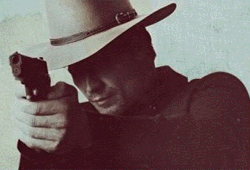 Elmore
Leonard has seen many of his novels transported onto the silver screen,
including Get Shorty, Out of Sight and Rum Punch,
which served as the basis for the Quentin Tarantino film Jackie
Brown. Despite having such notaries as John Travolta, Jennifer
Lopez, George Clooney and Pam Grier bring his creations to life, however,
it is the small screen’s Justified that the author appears
to be the most impressed with. “A lot of actors have done my characters
over the years, and they’re have been some good ones,” Leonard
remarked in January 2011, “but nobody as perfect in this world
as Tim.”
Elmore
Leonard has seen many of his novels transported onto the silver screen,
including Get Shorty, Out of Sight and Rum Punch,
which served as the basis for the Quentin Tarantino film Jackie
Brown. Despite having such notaries as John Travolta, Jennifer
Lopez, George Clooney and Pam Grier bring his creations to life, however,
it is the small screen’s Justified that the author appears
to be the most impressed with. “A lot of actors have done my characters
over the years, and they’re have been some good ones,” Leonard
remarked in January 2011, “but nobody as perfect in this world
as Tim.”
In the
FX drama Justified, Tim Olyphant stars as US Deputy Marshal
Raylan Givens, an old-school lawman who is transferred from Miami to
his childhood haunting grounds of Eastern Kentucky. The opening credits
of the series states that Justified is based on the short story
Fire in the Hole but in actuality Raylan Givens appeared in
two earlier Elmore Leonard novels, Pronto and Riding the
Rap. Although the character is fully established as the Raylan
Givens of Justified through both his actions and dialogue,
a few of the particulars have been altered in the transformation from
the page to the small screen nonetheless.
For instance,
Raylan Givens is divorced from wife Winona in both, with the ex remarried
to a real estate agent named Gary, but Givens has two small children
from the marriage as opposed to being childless on television. Furthermore,
it is the father of the Raylan Givens from the novels who died when
the future US Deputy Marshal was younger, not the mother, and there
are no hints or suggestions of the elder Givens being violent or a member
of the criminal element of Harlan County.
READ
MORE
Justified
and the Family Blood Feuds of Kentucky
 During
the later half of the Eighteenth Century, the backwoods of Kentucky
were inflicted with various feuds between warring families in the region.
These personal vendettas ran rampant but burned themselves out over
short periods of time as the main antagonists inevitably died during
the blood letting. While the majority of these feuds have subsided from
memory, the decades-long conflict between the Hatfields and McCoys has
evolved into a national folklore and become intimately associated with
the history of the state.
During
the later half of the Eighteenth Century, the backwoods of Kentucky
were inflicted with various feuds between warring families in the region.
These personal vendettas ran rampant but burned themselves out over
short periods of time as the main antagonists inevitably died during
the blood letting. While the majority of these feuds have subsided from
memory, the decades-long conflict between the Hatfields and McCoys has
evolved into a national folklore and become intimately associated with
the history of the state.
The FX
drama Justified, which features an Old West-style US Marshal
assigned to the Eastern Kentucky area where he was raised, mined that
history during the show’s second season by highlighting a still-simmering
feud between the fictitious families of Raylan Givens and those of criminal
matriarch Mags Bennett. “We came up with the idea of this Bennett
family, which has an age-old feud with Raylan and his family,”
executive producer Graham Yost told TV Squad in February 2011. “We
wanted to play with the idea of feud culture in that part of the world.”
While the
conflict between the Hatfields and McCoys was not sparked by any singular
event but a succession of smaller disputes—including an alleged
theft of a hog and drunken election day fisticuffs—that eventually
boiled over, the feud between the Bennetts and the Givens on Justified
had a clear-cut starting point during the era of Prohibition. “Bennetts
were running moonshine across the state line and agents busted them,”
Raylan Givens explains midway through the season. “They got it
in their heads it was the Givens tipped the Feds. My great uncle Harold
took a bullet to the chest and back and forth it went.”
READ
MORE
Justified
and the Lawmen of the U.S. Marshal Service
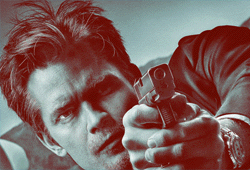 “I’m
stuck with a man who’s a lousy marshal but a good lawman,”
Art Mullen tells Raylan Givens during the second season of the FX drama
Justified.
“I’m
stuck with a man who’s a lousy marshal but a good lawman,”
Art Mullen tells Raylan Givens during the second season of the FX drama
Justified.
To truly
appreciate the underlying meaning of Mullen’s words, one must
first have an understanding of the original principles on which the
Marshal Service was created at the birth of the United States itself.
The Constitution on which the nation was forged, for instance, empowered
Congress to craft a federal judiciary system. Because of the inherent
difficulties in not only building a unified country made up of independent
states but establishing a central authority as well, the US Marshals
were founded in conjunction with the courts as a means to assist the
three branches of government in the execution of the laws of the land.
Historian
Frederick S. Calhoun was commissioned to author the official biography
of the US Marshals to coincide with the organization’s bicentennial
in 1989. Ironically enough—given Art Mullen’s comment—the
tome is simply entitled The Lawmen (Smithsonian Institution
Press, 1989) and offers a comprehensive narrative of the first two hundred
years of the Marshal Service. Due to the nature of the ideals upon which
the United States was founded and the necessity of ensuring that those
principles were upheld, Calhoun used the phrase with a slightly different
connotation than Mullen’s observation. “In the government
of laws, not men, they were the lawmen,” Calhoun wrote.
It is obviously
a much stricter interpretation of “lawman” than the mythical
western gunslinger of yore but sums up the function of the US Marshals
in a way that Art Mullen would appreciate. According to Calhoun, a marshal’s
job in regards to upholding the “rule of law” not only included
supporting the federal courts by serving subpoenas and warrants, making
arrests and escorting prisoners but representing the government at the
local level. They were thus equally responsible for enforcing the edicts
of the presidential and legislative branches as much as the judicial,
and had to do so out of respect for the law rather than any idealistic
belief in brandishing justice.
READ
MORE
Raylan
Givens and The Man Who Shot Liberty Valance
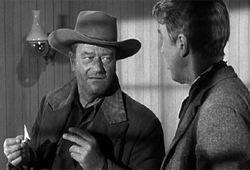 Raylan
Givens of the FX drama Justified is not one’s typical
modern day law enforcer. The US Deputy Marshal dons a full size cowboy
hat, for instance, to go along with his stylish suits and completes
the outfit with boots and a forty-five holstered around his waist. His
demeanor is both polite and courteous but he is also not above casually
telling a suspected criminal that “I don’t pull my sidearm
unless I’m going to shoot to kill.” In the pilot episode
of the series, meanwhile, Givens informs a gun thug for a Miami drug
cartel that he has twenty four hours to leave town or risk the consequences.
The Deputy Marshal follows through on the threat in the opening moments
of Justified, killing his prey as the clock ticks down and
the thug inevitably draws first.
Raylan
Givens of the FX drama Justified is not one’s typical
modern day law enforcer. The US Deputy Marshal dons a full size cowboy
hat, for instance, to go along with his stylish suits and completes
the outfit with boots and a forty-five holstered around his waist. His
demeanor is both polite and courteous but he is also not above casually
telling a suspected criminal that “I don’t pull my sidearm
unless I’m going to shoot to kill.” In the pilot episode
of the series, meanwhile, Givens informs a gun thug for a Miami drug
cartel that he has twenty four hours to leave town or risk the consequences.
The Deputy Marshal follows through on the threat in the opening moments
of Justified, killing his prey as the clock ticks down and
the thug inevitably draws first.
“You
do know that we’re not allowed to shoot people on sight anymore?”
his superior asks him afterwards. “And haven’t been for,
I don’t know, maybe a hundred years.”
Despite
an obvious respect and understanding of the law, Raylan Givens is a
throwback to the US Marshals of the Old West and their “shoot
first, ask questions later” mantra. “More like The Fugitive,”
he remarks of his profession when it is compared to Gunsmoke.
In reality, however, Raylan Givens is more akin to Wyatt Earp and Wild
Bill Hickok than Samuel Gerard, as well as a direct descendent of John
Wayne rather than Tommy Lee Jones. Just as the Duke was the epitome
of the classic Hollywood Westerns of yesteryear, Raylan Givens is representative
of the more complex Twenty First Century and a deep-rooted desire for
a return to simpler times.
While John
Wayne is best remembered for such big screen classics as Stagecoach,
The Searchers and True Grit, his small screen counterpart
Raylan Givens is more comparable to Tom Doniphon from the 1962 film
The Man Who Shot Liberty Valance. The epic is an exploration
of the shifting winds of society in the 1800s as the West evolved from
the justice of a gun to the rule of law. Like Givens, Doniphon finds
himself at the crossroads between those two worlds as he struggles to
balance his impending irrelevance with the better future he believes
in.
READ
MORE


 Justified