New
Man in Charge Offers Answers to Lost Questions
 During
the course of its first five seasons, the ABC drama Lost raised
a number of mysteries and unanswered questions within its narrative.
Viewers expecting a rapid fire sixth season that tied all those dangling
strings into a coherent tapestry, however, were no doubt disappointed
when that final season progressed at its own deliberate pace and placed
the emphasis on the characters of the series instead, as well as an
epic battle of good versus evil. This is not to suggest that the last
volume in the Lost saga was any sort of letdown—the fate
of the remaining survivors of Oceanic Flight 815 was effectively brought
to resolution through triumph, tragedy, tears and heroism while granting
a sense of genuine and heartfelt closure for fans of the series.
During
the course of its first five seasons, the ABC drama Lost raised
a number of mysteries and unanswered questions within its narrative.
Viewers expecting a rapid fire sixth season that tied all those dangling
strings into a coherent tapestry, however, were no doubt disappointed
when that final season progressed at its own deliberate pace and placed
the emphasis on the characters of the series instead, as well as an
epic battle of good versus evil. This is not to suggest that the last
volume in the Lost saga was any sort of letdown—the fate
of the remaining survivors of Oceanic Flight 815 was effectively brought
to resolution through triumph, tragedy, tears and heroism while granting
a sense of genuine and heartfelt closure for fans of the series.
The sixth
season of Lost also offered a fair number of answers, especially
within the controversial episode “Across the Sea.” The narrative
in that installment was different from anything the show had done before,
including a lack of regular cast members and a plot that took place
thousands of years in the past. In many ways, “Across the Sea”
was both a mythical fable and Biblical parable; even the only character’s
name mentioned in the episode, that of future island god Jacob, carried
a certain religious connotation to it. Still, Lost was able
to effectively trace the root of the show’s sprawling mythology
through the simple story of a lonely woman who raised two sons that
were not her own—by murdering their actual mother, no less—and
how her deception led to rivalry, betrayal, conflicting viewpoints on
the essence of humanity and an ultimate light versus dark, good versus
evil undertone to the Island.
But this
is Lost, of course, and the amount of questions that have amassed
through the years center on more than the origin of the island and would
take longer than one episode to answer. In order to satisfy viewers
hoping for a resolution that extended further than a mere ending to
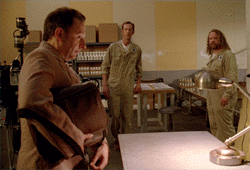
the show, the producers of the series concocted a minisode of sorts,
a twelve minute epilogue that deals exclusively with answers, and added
it as a special feature to the Lost DVD collection. Entitled
“The New Man in Charge,” the short video consists of two
simple scenes and sheds light on many of the mysteries that ensnared
the survivors of Oceanic Flight 815.
READ
MORE

Lost:
An Unexamined Life Is Not Worth Living
 In
The Apology, the dialogue written by Plato that details the
trial and death of Socrates, the accused philosopher makes the observation
that “an unexamined life is not worth living.” Socrates
meant it as a defense of his inquisitive nature regarding man’s
existence, but it could also serve as an epitaph to the final season
of the ABC drama Lost. The story arc that year featured an
“alternative universe” where Oceanic Flight 815 never crashed
on the island and detailed how the lives of the major Lostaways
were similar-yet-different because of it.
In
The Apology, the dialogue written by Plato that details the
trial and death of Socrates, the accused philosopher makes the observation
that “an unexamined life is not worth living.” Socrates
meant it as a defense of his inquisitive nature regarding man’s
existence, but it could also serve as an epitaph to the final season
of the ABC drama Lost. The story arc that year featured an
“alternative universe” where Oceanic Flight 815 never crashed
on the island and detailed how the lives of the major Lostaways
were similar-yet-different because of it.
In the
final episode—appropriately named “The End”—it
was revealed that this alternative universe was actually some sort of
purgatory created by the characters to serve as a gathering place where
they could remember their past and find each other again before moving
on to the afterlife. Although the purpose of their creation served a
higher purpose, it also functioned as a telling observation of how each
of them saw themselves and how far they had progressed in terms of dealing
with the personal demons they faced during their actual lifetimes.
James “Sawyer”
Ford is a prime example. When he was a boy, Sawyer’s family was
conned out of their life savings and his father reacted by killing both
his wife and then himself. Although the young James Ford vowed to some
day find the conman responsible, he turned to a life of criminal scheming
instead and even adopted the name of the person responsible for ruining
his life. When he arrived on the island, Sawyer was thus a bitter, conniving
loner with few morals. His time on Lost, however, showed growth
in the man as he evolved into a genuine leader and caring companion
to Juliet Burke.
The Sawyer
in the alternative world, meanwhile, isn’t Sawyer at all but simply
James Ford. And although his Southern smugness is still very much evident
in the first “flashsideways,” as they came to be known,
this James Ford was not a conman but a police detective.
READ
MORE
The
Gospel According to Lost: Love and Redemption
 The
beauty of the ABC drama Lost is that it can mean many different
things to many different people. With its large cast and sprawling narrative,
numerous religious, literary, philosophical and scientific references
and varied story-arcs ranging from adventure to romance to science fiction,
the series has something for everyone and is open to personal interpretation
more than any other show in the history of television. And while a statue
of the Egyptian goddess Taweret and an ancient, mystical protector of
the Island named Jacob may appear out-of-place within the realms of
Christianity, Lost still contains enough symbolic references
and universal concepts for modern-day believers in Jesus Christ to find
meaning within the show’s confines as well.
The
beauty of the ABC drama Lost is that it can mean many different
things to many different people. With its large cast and sprawling narrative,
numerous religious, literary, philosophical and scientific references
and varied story-arcs ranging from adventure to romance to science fiction,
the series has something for everyone and is open to personal interpretation
more than any other show in the history of television. And while a statue
of the Egyptian goddess Taweret and an ancient, mystical protector of
the Island named Jacob may appear out-of-place within the realms of
Christianity, Lost still contains enough symbolic references
and universal concepts for modern-day believers in Jesus Christ to find
meaning within the show’s confines as well.
At least
three book have been published since Lost premiered in 2004
that explore the series from a Christian perspective—Lost:
A Search for Meaning (Chalice Press, 2006) by Christian Piatt;
What Can Be Found In Lost (Harvest House Publishers, 2008)
by John Ankerberg and Dillon Burroughs; and The Gospel According
to Lost (Thomas Nelson, 2009) by Chris Seay. While all three rely
heavily on theology to compliment their thesis, the latter offers more
insight into the characters of the show and serves as an effective analysis
of Lost regardless of one’s religious beliefs.
Chris Seay
had an advantage over the other authors by writing The Gospel According
to Lost after the fifth season of the show, which featured a finale
that spun the series into a mythic battle of good-versus-evil as personified
by Jacob and the Man In Black. Although Lost had alluded to
such a dual concept from the very beginning—John Locke, after
all, explained the game of Backgammon as “two player, two sides”
and “one is light, one is dark” in the pilot episode—it
wasn’t until “The Incident” that their true meaning
came into focus. Seay points out, however, that the battle between these
“two sides” had been raging in various forms long before
Jacob and his counterpart were ever actually seen on screen.
READ
MORE


 Lost
Lost