Mad
Men Draws a Path from the Past to the Present
Mad
Men is a television anomaly. With its intentionally slow moving
plots and morally ambiguous characters, the series hardly exhibits the
ingredients for popular success. Then there’s the fact that it
airs on AMC, a former lightweight cable channel better known for rebroadcasting
popular motion pictures than quality original content. Since its premier
in 2007, however, Mad Men has gained a loyal fanbase, been
garnered with critical acclaim, racked up over fifty Emmy nominations
and has emerged victorious as “Best Drama” numerous times.
What makes
Mad Men so widely loved by fans and critics alike? Part of
the appeal is that while its premise may seem simple enough on the surface—a
1960s Madison Avenue creative director suffers from identity issues—the
show actually cuts a lot deeper as Mad Men is able to transform
both an industry and an often idealized era into a colorful world of
exotic intrigue.
Sterling
Cooper, the New York advertising agency that serves as the center of
Mad Men, is populated with an assortment of characters living
on the edge of modern times. Through the eyes of the account managers,
creative staff and even the secretaries, viewers have the rare opportunity
of experiencing what is now considered the norm when it was still fresh
and new. On the one hand, the era was a simpler time—when Reader’s
Digest was the first to report that cigarettes cause cancer, Right
Guard just introduced an aerosol deodorant for men and divorce was taboo.
It was also a period, however, when men often cheated on their wives
and both minorities and women were subservient in a world dominated
by white males. There is also the emotional impact on Mad Men
of seeing expectant mothers smoking and drunken businessmen taking a
glass of vodka with them for the drive home, or even a family leaving
the remnants of a picnic on the park grounds as litter.
READ
MORE

Mad
Men: Sterling Cooper is the Ad Agency of its Times
Although
the AMC drama Mad Men is an intense character study of complex
individuals adapting to a rapidly changing period in history, the series
also serves as a microcosm of the era and the struggles of society as
a whole to forge a new identity. While Don Draper, the main protagonist
of Mad Men, continually attempts to hide his past and fill
the emptiness deep inside with superficial relationships and meaningless
sexual encounters, his endeavors as creative director of advertising
agency Sterling Cooper display an astute ability to put his finger on
the pulse of the 1960s in ways that he can’t when it comes to
his own life. Draper’s “pitches” to his clients thus
often cut deeper and offer an accurate reflection of the contrasting
nature of the time period.
The first
season of Mad Men takes place in 1960 and in the pilot episode
Draper is left with the task of designing a new ad campaign for Lucky
Strikes. The previous decade is often seen as a period of prosperity
and innocence for Americans despite the fact that the nation was on
the verge of eruption. Although not aware of the changes ahead, society
still felt the uncertainty of the moment. Draper, in turn, comes up
with a simple and comforting slogan of “It’s toasted”
for Lucky Strikes. His subsequent explanation for the campaign, as well
as the advertising industry at large, reflects how Americans were able
to live in the 1950s while ignoring the growing friction within the
country.
“Advertising
is based on one thing: happiness,” he begins. “And you know
what happiness is? Happiness is the smell of a new car. It’s freedom
from fear. It’s a billboard on the side of the road that screams
with reassurance that whatever you’re doing is OK. You are OK.”
READ
MORE
'Unbuttoned'
is a Concise Introduction to the Mad Men Era
The
AMC drama Mad Men is more than a television series—it
also serves as a time capsule for a bygone age that borders on nostalgia.
Although the narrative is gripping and the characters are both relatable
and intriguing, part of the show’s appeal is its ability to capture
the spirit of the 1960s through its use of style and cultural icons
from the period. In her book Mad Men Unbuttoned: A Romp Through
1960s America (Harper Design, 2010), author Natasha Vargas-Cooper
offers a series of short and concise chapters on these edifying aspects
of the era that give further insight into the ongoing Mad Men
saga.
The first
section of Mad Men Unbuttoned is by far the most enjoyable
as Vargas-Cooper explores one of the central elements of the award-winning
series, the advertising industry. Not only does the author detail various
“schools” that were prevalent during the 1960s, she also
draws their direct relationship and influence on Don Draper, the creative
director of Sterling Cooper and the main protagonist of Mad Men.
Based on the various campaigns that Draper has developed during the
series, it is apparent to Natasha Vargas-Cooper that he is a disciple
of Leo Burnett, the revolutionary ad man based out of Chicago.
Burnett
had a very “down-to-earth” and “familiar” approach
to the business as opposed to using mere clever word play, and during
his lifetime crafted such legendary advertising icons as the Jolly Green
Giant, Tony the Tiger, the Pillsbury Doughboy and the Marlboro Man.
He also had an intense loyalty to his clients and kept his firm small
in order to better service them. Mad Men Unbuttoned offers
a quote from Don Draper, from when he was forced to sever ties with
Mohawk Airlines because Sterling Cooper had a shot at landing a larger
client, that could very well have been spoken by Burnett. “We
already have an airline,” Draper begins. “A good client
who trusts us, who likes our work, who pays their bill on time. They
don’t deserve to be thrown out the door for a wink from American.”
READ
MORE
Mad
Men & Philosophy: A Reflective Analysis of the AMC Drama
When
the AMC drama Mad Men debuted in July 2007, it immediately
set the standard for quality television. With its well-crafted characters,
detailed storylines that develop at a natural pace, examination of an
industry that played a pivotal role in our cultural history and set
during a time period that shaped modern society, the television series
quickly succeeded in winning the Emmy Award for Best Drama not only
in its first season but subsequent ones as well. While those qualities
have likewise made the show a critical darling and “must see”
programming for television fans, Mad Men is also the type of
series that is ripe for philosophical analysis as evidenced by the anthology
book, Mad Men and Philosophy: Nothing Is as It Seems (John
Wiley & Sons, 2010).
The characters
on Mad Men are unlike those found on most television shows.
Despite taking place in the 1960s, creator Matthew Weiner has crafted
an ensemble cast that is not mere caricatures of the times but fully-formed
personas that are both “likeable” and filled with questionable
morals and ethics as well. It is not surprising then that many of the
essays within Mad Men and Philosophy explore those characters
against the backdrop of such schools of thought as existentialism, objectivism
and authenticity.
Roger Sterling,
the senior partner of advertising firm Sterling Cooper, is a prime example.
It was Roger’s now-deceased father who co-founded the company
and the younger Sterling merely followed in his parental footsteps.
Roger Sterling thus has an air of entitlement about him and is the personification
of the phrase “someone who was born on third base and thinks he
hit a triple.” In “The Existential Void of Roger Sterling,”
Raymond Angelo Belliotti explores the character through the philosophy
of Soren Kierkegaard, who saw life as a series of stages. According
to the author, it is Kierkegaard’s first stage, known as the aesthetic
stage, which best exemplifies the Mad Men character.
READ
MORE
Mad
Men: The Wisdom of Roger Sterling
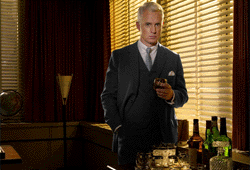 Of
all the characters on the AMC drama Mad Men, Roger Sterling
Jr. is arguably the most colorful, quick-witted and humorous of the
cast. His womanizing ways and membership in the privileged upper-class
also makes Roger Sterling a reflection of the well-to-do male of the
1950s. In 1923, his father co-founded the Madison Avenue advertising
firm Sterling Cooper and the younger Sterling followed in his footsteps
by becoming an ad man himself. When Roger Sterling Sr. died, his stake
in the firm was left to his son and in effect made him successful by
default.
Of
all the characters on the AMC drama Mad Men, Roger Sterling
Jr. is arguably the most colorful, quick-witted and humorous of the
cast. His womanizing ways and membership in the privileged upper-class
also makes Roger Sterling a reflection of the well-to-do male of the
1950s. In 1923, his father co-founded the Madison Avenue advertising
firm Sterling Cooper and the younger Sterling followed in his footsteps
by becoming an ad man himself. When Roger Sterling Sr. died, his stake
in the firm was left to his son and in effect made him successful by
default.
But Roger
Sterling is not simply some “stuffed shirt” used to getting
his way. He exhibits both intellect and charm in his dealings with clients
of the firm that bares his name and while many of his comments are both
outdated and even offensive by today’s standards, they still carry
a level of philosophical wisdom about them nonetheless. They are also
often quite amusing.
“You
know what my father used to say? Being with a client is like being in
a marriage. Sometimes you get into it for the wrong reasons and eventually
they hit you in the face.”
“If
you put a penny in a jar every time you make love in the first year
of marriage, and then you take a penny out of the jar every time you
make love in the second year, you know what you have? A jar full of
pennies.”
READ
MORE

