The
Mercury Men Webseries Review
 During
the first half of the Twentieth Century, serials were a staple of the
Saturday matinee movie theater. Screened before the feature film, these
short “chapters” of a longer narrative told the adventures
of such science fiction and comic book related characters as Flash Gordon,
Captain Marvel and the Green Hornet. Each of the approximately twenty-minute
installments ended with a cliff-hanger scenario, ensuring that the theaters
would be packed the following week as kids across the land waited in
bated anticipation for what would come next.
During
the first half of the Twentieth Century, serials were a staple of the
Saturday matinee movie theater. Screened before the feature film, these
short “chapters” of a longer narrative told the adventures
of such science fiction and comic book related characters as Flash Gordon,
Captain Marvel and the Green Hornet. Each of the approximately twenty-minute
installments ended with a cliff-hanger scenario, ensuring that the theaters
would be packed the following week as kids across the land waited in
bated anticipation for what would come next.
Pittsburgh
native Christopher Preksta already demonstrated his nostalgic fondness
for the old radio serials and comic book heroes of a bygone age with
his 2008 webseries Captain Blasto, which told the story of
high school loner who transformed himself into the fictitious title
character in order to get noticed. For his second online narrative,
Preksta has turned to the old movie serials of the 1930s and 40s for
inspiration with the black-and-white sci-fi thriller The Mercury
Men.
“The
men of Mercury are the first race of men, made of pure light,”
it is explained during the narrative. “And they’ve existed
for endless generations. On one planet. And in a fraction of the time,
man—made of the very dirt of the earth—lept into the stars.
They’re afraid of us.”
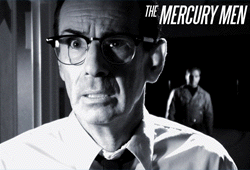
The Mercury
Men of The Mercury Men have the form of a human but appear
as bright illuminations devoid of any physical features. They also have
the ability to throw deadly balls of light that wipes out the remaining
late night employees of a Pittsburgh office building. Except for one,
that is—the middle-aged, horned-rimmed glasses wearing Edward
Borman (Mark Tierno). Borman initially manages to elude the Mercury
Men until aerospace engineer Jack Yaeger (Curt Wootton) arrives, dressed
in a 1940s aviator outfit and armed with a Flash Gordon-style pistol
that shoots special bullets.
READ
MORE

The
Mercury Men and Flash Gordon Serials of the 1930s
The
webseries The Mercury Men is an old school sci-fi drama that
pays homage to science fiction of the past, from the original Star
Wars of 1977 to 1950s films like The Day the Earth Stood Still
to even the psychological thrillers of Alfred Hitchcock. It’s
most notable influence, however, are the Saturday matinee serials of
the 1930s and 40s. Taking their cue from pulp magazine serialized fiction,
in which new chapters of a long-running narrative appeared in each publication,
production studios like Universal, Republic and Columbia created a series
of short films that were interconnected by cliffhanging endings and
shown in weekly installments at local movie theaters prior to the main
feature. The plots were usually centered on pre-existing pop culture
characters from both radio and comics, and were an essential part of
America’s Saturday afternoon routine.
While the
advent of television brought about the end of matinee serials, many
later-day filmmakers found inspiration from those “thrilling days
of yesteryear.” George Lucas is arguably the most famous of those
creators, and both the Star Wars and Indiana Jones film franchises
initially evolved as modern-day updates of the old Saturday serial.
Webseries auteur Christopher Preksta, however, has taken the concept
into even more contemporary of times with The Mercury Men—the
“cliffhanger” narrative device perfected by the matinee
serials is a perfect companion to the traditionally shorter episodes
of the new medium, and The Mercury Men is finely crafted to
emulate the old-school style of storytelling.
Although
Captain Marvel, Dick Tracy and the Lone Ranger were amongst the characters
that once graced the silver screen during the movie serial heyday, arguably
the most popular adaptation was the Alex Raymond comic strip Flash
Gordon. A total of three serials were based on the polo-playing,
Yale graduate brought to life by actor Buster Crabbe, starting with
the original Flash Gordon in 1936, Flash Gordon’s
Trip to Mars in 1938 and Flash Gordon Conquers the Universe
in 1940. The main antagonist in each of these serials is Ming the Merciless,
emperor of the planet Mongo who is intent on destroying Earth. In the
initial comic strip, Ming bombards Earth with a series of meteor attacks
and during the 1936 serial, literally hurls Mongo on a collision course
to smash the planet into smithereens. In both instances, Flash Gordon
and his comrades Dr. Alexis Zarkov and Dale Arden travel by rocket ship
to Mongo in order to prevent the destruction of their home world. Flash
Gordon’s Trip to Mars, meanwhile, contains Ming’s attempt
to drain the Earth’s atmosphere with a powerful beam of light,
and in Flash Gordon Conquers the Universe, the evil emperor
release a deadly plague against mankind known as the Purple Death.
READ
MORE

