
TV Tunes and the Soundtrack of a Generation
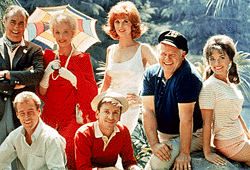
Actor Barry Williams named his 1992 autobiography Growing Up Brady: I Was a Teenage Greg. While Williams had the unique perspective of literally growing up on television—he was fifteen when The Brady Bunch premiered in 1969—in actuality an entire generation of Americans can say that they “grew up Brady” as well. Like no entertainment medium before it, television has had an effect on culture, society and individuals for both the good and the bad. Those who were raised in the 1970s are a prime example and witnessed a Golden Age of Television Sitcoms along the likes of The Mary Tyler Moore Show, M*A*S*H, All in the Family and The Jeffersons. And those television experiences of their childhood have stayed with them through the years.
Pittsburgh cabaret actress Christine Laitta is proof of that fact. “I have written other cabaret shows about me and my life but I wanted to write something where the audience is an integral part of the show,” she explains in regards to her TV Tunes Sing-a-Long creation. “I really wanted to make them feel like we were all reliving the moments together. I also had a feeling there were a lot of TV theme fans out there.” Armed with a collection of classic television songs from the 1960s, 70s and 80s, Laitta first launched her TV Tunes showcase in 2006 at the Cabaret at Theater Square. The response has been consistently enthusiastic in the years that followed, as audience members join in and sing along with Chris Laitta and her exceptional band to what amounts to the soundtrack of an entire generation. It’s not only a testament to the timeless nature of the catchy tunes and the nostalgic feelings they conjure, but a testament to the impact of television as a medium as well.
“Space… the final frontier…”
Although the lone three seasons of the original Star Trek aired during the 1960s, it was the show’s syndication run in the following decade that truly elevated it to a cult status level like no other television series. Despite limited budgets, cheesy special effects and the very deliberate acting style of William Shatner, Star Trek also had a significant impact on modern society. An untold number of children were influenced by the series, not only play acting their own scenes in their youth but pursuing science as career in their adult years as well. One can quite literally say that the technology of Gene Roddenberry’s creation opened imaginations that would later lead to actual advances in the field.
Star Trek had positive effects beyond science, however. The crew captained by James T. Kirk was diverse in terms of race, gender and nationality. There was Lieutenant Nyota Uhura, an African American woman serving as chief communications officer; Russian Pavel Chekov, meanwhile, was the navigation officer. Even fictional species unfamiliar to mankind were represented in Vulcan science officer Spock. Star Trek showed a future where males and females, blacks and whites, Americans and Russians all worked together in unison for the common good. The show in effect instilled values in a new generation that the generations before never experienced.
“Fish don’t fry in the kitchen, beans don’t burn on the grill…”
The generations that came before were also raised in a culture where racism ran rapid. Interaction between blacks and whites was often limited and “separate but equal” was the rule if not always the reality. Then the 1960s came along with Civil Rights and the efforts of millions of African Americans to be treated like normal citizens. Television in the 1970s reflected the changes taking shape in society with network shows like The Jeffersons and Good Times airing alongside The Bob Newhart Show and The Odd Couple. And guess what? It did not matter the race, people of any color experienced the same struggles as everyone else and found themselves in situations worthy of the comedic treatment as well. In the end, George Jefferson wasn’t that much different than Bob Newhart and J.J. “Dynomite” Evans could be just as funny as maintenance man Dwayne Schneider from One Day at a Time. Through such depictions, television shows of the 1970s helped change the preconceived notions of an entire generation as much as anything else.
“Schlemiel! Schlimazel! Hasenpfeffer Incorporated!”
It wasn’t just African Americans who fought for equality in the 1960s but women as well. Television in the 1970s likewise reflected those changes, most prominently with The Mary Tyler Moore Show. Thirty-year-old Mary Richards, alone and single, moves to Minneapolis in order to begin a new life. Defying the traditional stereotype that a woman’s place was in the home with a husband and kids, she not only succeeded at television station WJM but changed the television landscape forever. “Her self-titled sitcom was able to be a sophisticated show about grownups among other grownups, having grownup conversations,” James Poniewozik of Time magazine wrote of Mary Tyler Moore in 2007. “Moore made Mary into a fully realized person, iconic but fallible, competent but flappable, practical but romantic. Mary was human and strong enough to be laughed with and laughed at, and that was the kind of liberation that mattered most.”
Mary Richards wasn’t alone when it came to television sitcom females during the 1970s—there was also the story of two single working girls employed at the Shotz Brewery in Milwaukee that likewise inspired the youth of the time. “I loved Laverne because she was ‘tough’ and we would often quote scenes from the show,” TV Tunes songstress Chris Laitta says in regards to watching Laverne & Shirley with her best friend at the time. “I think we relate to TV characters because it seems as if they are living glamorous, adventurous lives that all seem to come together at the end of the hour.”
“Just sit right back and you’ll hear a tale, a tale of fateful trip…”
Let’s face it, we have all been raised by television. Like the passengers on the S.S. Minnow, we set off on a three-hour tour but were sidetracked by Minneapolis TV station WJM, the Korean War and the middle-class struggles of James and Florida Evans instead. We learned the meaning of family, even ones that were non-traditional and dysfunctional. We learned about love and loss and Happy Days. But unlike Gilligan, the Skipper and Mary Ann, we were not marooned on a desert island and left to fend for ourselves. Instead we shared these television moments with an entire generation and the after effects still resonate even if we have gotten older.
“When we are young, we are not only impressionable but it is when we have the greatest ability for suspension of disbelief,” Chris Laitta offers as to why television influences us to the degree in which it does. “We can totally let go and put ourselves in the show. As we get older we have so many distractions that it is rare that we even sit down and watch a show without multitasking. I also believe that shows from my childhood dealt with real relationships between siblings, friends, co-workers and how we worked through situations.”
Television continues to have the same effect in the Twenty First Century. The ABC drama Lost, for instance, raised an interest in philosophy and spirituality because of its intellectually challenging premise. The CSI franchise on CBS, meanwhile, has inspired a new generation to pursue forensics as a career in much the same way that Star Trek did decades earlier in regards to science. Or even in the same way in which Chris Laitta once had her career choice influenced by television. “I took a job on a cruise ship because I thought it would be like The Love Boat,” she readily admits. “It was nothing like The Love Boat.” While that experience may not have gone as planned, it was still because of television that the Pittsburgh resident ended up in an alternative career.
“I also became a professional actor,” she says. “I wanted to be able to live in all of those different worlds as a different person.”
In that sense, Christine Laitta is truly fortunate. Not only does she still get to pretend that she is Laverne DeFazio like she did in her childhood, but she also gets to share it with the audiences that attend her TV Tunes Sing-a-Long showcase as well.
Now that’s what “making our dreams come true” is all about.
Anthony Letizia (December 13, 2010)
Discuss on the alterna-tv.com Forum
