
The Television Will Be Revolutionized
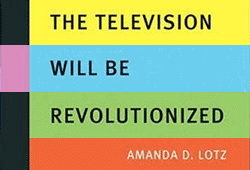
Lotz divides these developments into five areas: technology, creation, distribution, advertising and audience measurement. In the days of old, for instance, one could only watch television on a literal television, but recent years have seen a multitude of technological advancements—such as the DVR, Video-On-Demand, portable devices like the iPod and even a growth in mobile phone capabilities—that allow television viewing to no longer be limited to the home. More importantly, the audience is no longer a slave to the scheduling whims of network executives, as these new devices allow for the viewing of a television show any time, as well as any place, one is inclined to do so.
The more intriguing elements of Amanda Lotz’s analysis, however, is how all these changes on all these levels will increase the potential for a wider-ranging and more diverse level of television production. HBO and Showtime have obviously had an effect, bringing what Lotz calls an “artistic” approach to television production by creating “content with budgets and production values once common only to films produced by major studios.” But even the way these channels schedule their shows, their use of storytelling structures that do not have to rely on commercial interruptions, and the lack of advertising revenue to turn a profit has also had profound repercussions.
The cause-and-effects that Lotz discusses go deeper than cable channels, however, as the author argues that even the smaller revenue now generated by networks and studios will play a role in allowing a wider-variety of programming. In the past, the predominant method of producing a television show was through deficit financing, where a studio suffered an initial loss in making a series with the hope and expectation that it would both recoup those losses and show a profit through the eventual selling of syndication and international rights. This philosophy led to a boom in the 1990s when not only comedies like Friends and Seinfeld turned into billion dollar syndication empires, but even the drama ER was able to muscle substantial licensing fees—what a network pays per episode for a television series—from NBC. But as network viewership drops and television-watching becomes fragmentized, those levels of financial rewards dwindle as well.
The early part of the Twenty First Century, meanwhile, has seen a rise in financing experimentation, including “cost plus” (where a network pays the studio production costs plus a ten percent profit for all rights associated with a series), single sponsorship and the creation of shows with varying expense structures and syndication values. Conventional wisdom, for instance, has always held that a series created for a cable network could never be later sold into syndication, but F/X’s The Shield and HBO’s Sex and the City eventually proved that wisdom wrong. Freed from needing a Seinfeld to turn a profit in syndication, networks and studios will be more inclined to experiment with grittier, cutting-edge shows now that the potential for financial reward has been established.
The advent of reality shows has also assisted more creative and risk-taking endeavors make it through production and onto the airwaves. Networks were able to reduce expenses in the past by broadcasting reruns of a series at no additional cost, as licensing agreements allowed for both first-run and second repeat airings of a show. Cable and subscription channels like HBO, however, began broadcasting entire seasons straight through with no repeats, and it wasn’t long before the networks experimented with such scheduling arrangements as well. The WB was the first, splitting a time slot in 2000-2001 with both Felicity and Jack & Jill, but this meant the network was doubling its costs by paying for two shows where it previously had only one such expense. Reality shows, however, made it more feasible because of the lower expenses associated with the medium. Despite the grumblings that both critics and fans of quality television make in regards to the perceived multitude of reality shows on network television, the smaller costs do help subsidize the higher-risk series that don’t repeat as well, such as 24 and Lost.
DVDs have had another profound affect on television profits. Although industry insiders were initially skeptical about the success rate full-season packages of television shows would have on DVD, in 2005 sales of TV-On-DVD reached $2.6 billions dollars. Even “less popular” shows, i.e., series that did not rank high in the Nielsen ratings, rang up remarkable numbers—by the end of 2004, for instance, Buffy the Vampire Slayer had earned $123.3 million from DVD sales. Wonderfalls, a FOX series canceled after only four episodes due to poor ratings, sold twenty-five thousand copies in the first two weeks it was released on DVD, while Firefly, another FOX series canceled prematurely, sold five-hundred thousand copies in less than two years.
Ironically, some of the more popular series on television are also the weakest DVD performers, including the CSI franchise. Such statistics reveal that niche and genre shows have a stronger, more viable fanbase from which to exploit profits, and while there was once a limited quantity of these shows because of low ratings, DVD sales prove they are a profitable commodity. The advent of downloadable episodes from Apple’s iTunes has also had an affect on the money-making ability of shows with marginalized ratings. The NBC sitcom The Office, for instance, saw an increase in its network ratings when episodes were first made available on iTunes, and subsequent episodes consistently ranked in the upper echelons of iTunes downloads.
While little concrete information is available on the iTunes profitability margin, industry insiders have speculated nonetheless. An article in Business Week, for instance, reported that Desperate Housewives generated $11.3 million in network advertising revenue per episode, which in turn amounted to forty-five cents per viewer. If ABC receives $1.20 of the $1.99 per iTunes download, as is generally estimated, the profit-margin per viewer is significantly higher online. Could this in turn lead to a television series relying exclusively on the iTunes model for production and distribution? Amanda Lotz believes so, and offers Arrested Development as an example. The FOX comedy averaged 4.3 million during its final season; using the standard production cost of $1.8 million per episode, it would take only 1.25 million viewers paying the iTunes $1.99 to cover such expenses. Of course, a new television series produced exclusively for iTunes could never garner the necessary publicity to attain even that low of an audience, but Lotz foresees a future where network television acts more like an “advertising” medium, with first seasons initially broadcasted in the traditional form before the lower-rated shows are then moved onto the Internet for later seasons.
The future that Amanda Lotz describes is one where the audience is king, with advanced capabilities for viewers to dictate the types of shows that are produced in ways more diverse and financially potent than simply tuning in on a specific day at a specific time. Still, the author is cautious about such a future. “Although expanded viewer sovereignty still seems possible in this nascent stage of the post-network era, the history of distribution tell a different story,” she warns. “All too frequently emergent technologies provided multiplicity and diversity in their infancy, only to be subsumed by dominant and controlling commercial interests as they became more established.”
Yes, the television will be revolutionized—and vice versa—but the future of that revolution is also uncertain, and the definitive battles have yet to be fought. As Amanda Lotz herself writes, “Stay tuned: a battle royal has just begun.”
Anthony Letizia (January 28, 2008)
Discuss on the alterna-tv.com Forum
