
Castle and Steampunk Culture
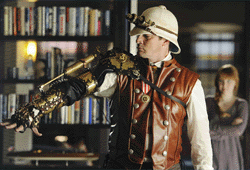
The ABC series that Falksen refers to is another crime drama but one that is more focused upon its characters than most other recent entries into the genre. The show centers on Richard Castle, a mystery writer who is acting as a consultant for the New York City Police Department, and homicide detective Kate Beckett, the inspiration for Castle’s current series of murder novels. The title character on Castle has a childlike-wonder and curiosity about him, while his partner in crime solving is more grounded and level-headed. Coupled with the setting of the Big Apple, the series often contains episodes that likewise take them into various subcultures, and in October 2010 they accepted G.D. Falksen’s challenge by creating an installment that did indeed feature Steampunk within its narrative.
According to Jeff VanderMeer in The Steampunk Bible (Abrams Image, 2011), the phrase was first coined by writer K.W. Jeter in 1987 but it wasn’t until the New York Times published an article on May 8, 2008, that the subculture became more widely known. “Over the past fifteen years, Steampunk has gone from being a literary movement to a way of life and a part of pop culture,” Vandermeer writes. “A Steampunk aesthetic now permeates movies, comics, fashion, art, and music, and has given a distinct flavor to iconic events such as Maker Faire and the Burning Man festival.”
But what exactly is Steampunk? “It’s a subculture that embraces the simplicity and romance of the past but at the same time couples it with the hope and promise and sheer super coolness of futuristic design,” Richard Castle explains to Kate Beckett in the episode “Punked.” Jeff VanderMeer likewise offers a three-pronged definition in the opening pages of The Steampunk Bible. “First, it’s simultaneously retro and forward-looking in nature,” he observes. “Second, it evokes a sense of adventure and discovery. Third, it embraces divergent and extinct technologies as way of talking about the future.”
During their course into the investigation of a murdered mathematical genius who worked for a financial investment firm, Richard Castle and Kate Beckett find themselves at the doorstep of a plush private club for members of the Gaslight League. To enter, the two must answer a series of questions—until Beckett pulls out her badge and expedites their entry. Castle, on the other hand, is intrigued by the queries.
“What was the exact number of pounds that Mr. Fogg bet that he could travel around the world in eighty days?” is the first inquiry, with the second being, “Name the volcano that led to the center of Earth?”
The answers are “twenty thousand” and “Sneffels,” respectively, and both are found within the works of Nineteen Century writer Jules Verne. Verne, along with his contemporary counterpart H.G. Wells, are prominent influences on Steampunk society. Between them, they wrote some of the most classic works of science fiction, including Around the World in Eighty Days, A Journey to the Center of the Earth and Twenty Thousand Leagues Under the Sea by Verne, and The Island of Dr. Moreau, The Time Machine and The War of the Worlds by Wells. That is not to suggest that Steampunk is merely a science fiction-based movement—it is the deeper understanding of the writings of both Jules Verne and H.G. Wells that actually serves as the influence.
“What makes Verne’s novels unique and most inspiring to Steampunks is that his writing depended on inventing plausible technologies to drive his stories,” Jeff VanderMeer writes in The Steampunk Bible. “Verne went to great pains to make that technology unique, and his mechanical marvels are as memorable as his characters, like the self-sustaining submarine Nautilus from Twenty Thousand Leagues Under the Sea.”
H.G. Wells, on the other hand, “viewed his stories as fantasies and his machines as art, not artifacts.” Wells was also less interested in the science of his fiction as he was in the social explorations that his novels likewise contained.
“It is Wells’ preoccupation with the social question, not just with otherworldly gadgets, that informs certain aspects of Steampunk culture,” VanderMeer continues. “Social awareness is pivotal to the best practitioners of Steampunk, which has also been conscious of the Nineteenth Century’s less inspiring moments. While that era featured great strides in aesthetics and technologies, politically it was tainted by colonialism, imperialism, and racism—the first two issues, in particular, at the forefront of Wells’ scrutiny…. His particular gift was to use science fiction elements to combine an entertaining story with serious explorations of important issues.”
These two competing yet complimentary visions are reflected in the explanation offered by the Gaslight League’s president, Owen Peterson. “We’re just romantics,” he tells Richard Castle and Kate Beckett. “Look at the world, don’t like what we see so we recreate it here. An oasis where human potential and ingenuity is limitless. Where there’s poetry and wonder and meaning, even in death.”
The world in which the two main characters of Castle find themselves is indeed filled with wonder. The club is described as 1892 Victorian London, and encompasses many of the key elements of Steampunk culture. The members of the Gaslight League are dressed in dramatic fashion that reflect the times and are in line with what Libby Bulloff describes in The Steampunk Bible as the four main styles of Steampunk fashion—the street urchin, the tinker, the explorer, and the aesthete.
“Fashion is the window into the Steampunk culture,” Jeff VanderMeer elaborates. “It’s the one element that uniquely identifies a Steampunk from any other kind of punk, the outward expression of an inner narrative. The clothes give a human touch to the Steampunk that counterbalances the emphasis on antiquated technology and machines, opening up whole new avenues for participation.”
Antiquated technologies and machines—as VanderMeer describes them—are another major component to the Steampunk movement. Within the walls of the Gaslight League on Castle are numerous scientific gadgets, a flatscreen television that shows faded black-and-white images from a by-gone age, a replica time machine and a functioning penny-farthing. Richard Castle is immediately fascinated with the Nineteenth Century bicycle with the large wheel in front and smaller one in back, and immediately asks if he can ride it.
Unfortunately, the opportunity never arises but Richard Castle is later seen donning the clothing of an explorer, replete with a white safari hat. The outfit also contains a mechanical contraption on his arm, a device that could just as well have been contained within the pages of Jules Verne or H.G. Wells.
The works of both Verne and Wells were not merely meant for entertainment, however, as they are also filled with warnings about scientific discovery run amuck, the failings of society and the pitfalls of human nature. “The world Steampunk has inherited is the technological nightmare that Verne and Wells predicted at their most cynical,” Jeff VanderMeer writes in The Steampunk Bible. “Taking from Verne the gift of a fantastical and playful imagination, and utilizing Wells’ sociological approach to facilitate changing the future, Steampunk rewrites blueprints, reinvents steam technology, and revamps the scientific romance to create a self-aware world that is beautiful and at times nostalgic, but also acknowledges dystopia.”
In the end, the motive for the murder that Richard Castle and Kate Beckett are investigating is one of the oldest known to man—revenge. That particular emotion is inherent in human nature regardless if one is part of mainstream society or a subculture like Steampunk. Within the narrative of “Punked,” however, Castle also paints a picture of Steampunk that is filled with the wonder and potential of the movement while also grounding it in the reality of life and death in the process. From the images within the private club of the Gaslight League to the fascination it elicits in the eyes of Richard Castle, it is a worthy portrait of Steampunk—and an entertaining episode of Castle as well.
Anthony Letizia (June 22, 2011)
Follow alterna-tv.com: Facebook - Google+ - Twitter - RSS Feed
