HOME
ABOUT
TELEVISION GUIDE
THE INDUSTRY
WEBSERIES REVIEWS
FACEBOOK
RSS FEED
TWITTER
CONTACT


Television Reviews

Welcome to the Third Golden Age of Television. Although still obviously young, this century has already produced more than its fair share of timeless storytelling. If “quality” is defined by great characters and great dialogue, then the writing on television has never been better. Dexter and Justified, to name just two, exhibit a style and substance that can stand up against even the most literate of modern playwrights. Mad Men and Lost, meanwhile, could very well be the best character-driven shows in the history of television. But this particular Golden Age isn’t just about dramas, however. The Office and It’s Always Sunny in Philadelphia, for instance, are just as funny as the past classics even though they are fundamentally different than a “traditional” series. Whether it’s great writing or character development, a psychological study or social critique, television indeed has it all.

—alterna-tv.com


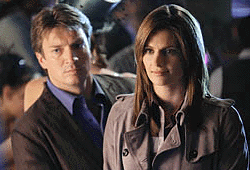
Castle Brings Modern Edge to the Old-School Detective Genre

“There are two kinds of folks who sit around thinking about how to kill people,” Richard Castle explains at the start of the ABC drama Castle. “Psychopaths and mystery writers. I’m the kind that pays better.”

Mystery writers assisting law enforcement in tracking down murderers was originally championed in the mid-1970s by television writers Richard Levinson and William Link with the short-lived Ellery Queen. Set in the 1940s, author Ellery was inevitably drawn into the latest New York City slayings being investigated by his father Inspector Richard Queen and would famously gather all of the suspects together at the end of each episode and subsequently reveal the identity of the culprit. Unfortunately, Ellery Queen failed to attract a large enough audience to keep it on the air longer than one season, but Levinson and Link enhanced the concept in their creation of Murder, She Wrote. Changing the setting to both contemporary times and tranquil Maine, as well as the gender of the main protagonist, the two crafted one of the longest running and most successful crime series in television history.

Castle, meanwhile, explores the same terrain that Levinson and Link traveled in the 1970s, 80s and 90s but gives the “mystery writer turned real life detective” a more modern edge and style. A lot has changed, after all, within the crime genre since Murder, She Wrote ended in 1996. Classic detective shows of the past have given way to the forensic dramas of the present, with the procedural aspects of crime solving overshadowing the intellectual connecting-the-dots of yesteryear. Castle thus walks the fine line between its modern day contemporaries and old-school premise while mixing its own ingredients for success in the process.

READ MORE


Dexter Season Five Review

It would be easy to dismiss the fifth season of the Showtime drama Dexter as a transitional one. By the end of the previous installment, after all, the main original creative forces behind the series, including Daniel Cerone, Clyde Phillips and Melissa Rosenberg, had all left the show. Title character Dexter Morgan (Michael C. Hall), meanwhile, found his own life in an equal period of upheaval after the events of season four led to the loss of his wife Rita at the hands of the serial killer known as Trinity. Just as that season was an exploration of whether or not Dexter could “have it all,” however, season five was an examination of what happens when someone loses everything and ultimately measures up to the standards set by its predecessors despite any preconceived perceptions.

The first few episodes did indeed feel “transitional” as past events were both immediately dealt with and pushed into the background so that a new direction for the series and the character could emerge. That is not to say that Rita’s death was simply swept under the rug and forgotten—its impact still hung in the air throughout season five as Dexter struggled to deal with both grief and guilt even if the murder was not at the forefront of the narrative. The “transitional” element also evaporated once the main storyline fully kicked in and Dexter Morgan found himself on an actual journey of further growth rather than merely crossing a bridge between two distinct phases of his life.

Whereas past seasons of Dexter primarily featured a solitary “Big Bad,” the fifth installment centers on a group of villains that are arguably more brutal and sadistic than any that the anti-hero of the series has faced in the past. The group—led by a charismatic self-help guru named Jordan Chase (Jonny Lee Miller)—preys on young women, rapes and tortures them for extended periods of time before killing them and dumping their bodies in a swamp. Dexter initially believes there is only one culprit but realizes otherwise when he discovers a lone survivor locked in an attic.

READ MORE


Falling Skies is a Humanistic Sci-Fi Drama

Although there have been numerous science fiction television shows in the history of the medium, very few have centered on the pretext of an alien invasion. The most famous was also the most successful, the classic FOX drama The X-Files. The series was a combination, however, of standalone episodes in which FBI agents Fox Mulder and Dana Scully investigated a wide variety of supernatural occurrences and mythological installments involving a government conspiracy regarding a pending alien occupation. Then there was the short-lived 1996 NBC drama Dark Skies, which again focused on a secret war between the human race and an alien species intent on domination against the backdrop of actual 1960s historical events.

It took executive producer Steven Spielberg and the year 2011 until another original alien invasion show hit the airwaves, the TNT series Falling Skies. The drama is more direct with its narrative in that by the time the pilot episode begins, the aliens have already completed their takeover of planet Earth. There is also a lack of conspiratorial cover-up in Falling Skies—the aliens came, the United States and other nations believed their intentions to be peaceful and the aliens in turn launched an attack that wiped out a large portion of the world’s population. The aliens also stayed, using mechanical robots to roam cities and regions while kidnapping children and implanting them with a spinal “harness” to control both their minds and their actions.

Small groups of stragglers survived the initial attack, however, and have formed military units of “fighters” and “civilians.” In this sense, Falling Skies is more akin to the re-imagined Battlestar Galactica of the Syfy channel than either The X-Files or Dark Skies. In the hands of executive producer Ronald D. Moore, that updated version of the 1978 original is less of a cheesy response to the then raging Star Wars craze and more of a psychological analysis of survival when a species is pushed to the brink of extinction. Falling Skies inevitably has the same quality in that the series isn’t so much about a defiant battle against a superior alien race that proves the versatility of mankind but an examination of surviving against all odds, protecting one’s family, not losing faith and finding a way to eventually fight back.

READ MORE


ADDITIONAL ALTERNA-TV.COM REVIEWS:

The Big Bang Theory and the Revenge of the Geeks An overview of the CBS sitcom The Big Bang Theory and how the series has achieved success despite its main characters being genius geek scientists.

Bones Season One: A More Likeable David and Maddie Review of the FOX forensic drama about an FBI agent and an anthropology expert who solve crimes together, highlighting the show's Moonlighting roots and quirky characterizations.

Burn Notice Season One Review of the USA Network series about a former spy trying to clear his name with the assistance of an oddball-assortment of friends and family.

Dark Skies: Government Conspiracies, UFOs and the 1960s Review of the short-lived, late 1990s sci-fi drama that intertwines a UFO governmental conspiracy with actual events of the 1960s to create a fictitious alternate history.

Dexter Season One: Anatomy of a Serial Killer Review of the first season of the Showtime series about a vigilante serial killer who works as a blood-splatter analysis for the Miami Police Department.

Dollhouse Season One Review of the Joss Whedon series about an illicit mind-swapping organization and an FBI agent’s quest to bring the organization down.

Dollhouse Season Two Review of the second season of the Joss Whedon series about an illicit mind-swapping organization and the “evil” corporation intent on using the technology for its own nefarious purposes.

Ellery Queen Revisited: Classic 1970s Detective Noir Review of the NBC “whodunit” detective series that followed the adventures of mystery writer Ellery Queen in 1940s New York City.

Firefly Revisted: It's the Characters that Matter Review of the short-lived Joss Whedon sci-fi drama that has amassed a large cult following, partially due to the well-crafted characters that resonate with viewers.

Fringe Season One Review of the first season of the FOX drama that follows a small FBI task force investigating strange phenomenon on the edge of fringe science.

Fringe Season Two Review of the second season of the FOX drama, in which the show’s overarching mythology involving an alternative reality gets further fleshed out.

Fringe Season Three Review of the third season of the FOX series, in which the show further distances itself from sci-fi dramas of the past as it continues to explore both its characters and overarching mythology.

The Gates is a Welcomed Addition to the Genre Review of the ABC drama about a private suburban community populated with supernatural beings struggling to appear more human.

Heroes Season One: An Extraordinary Beginning Review of the first season of the NBC series about a group of ordinary individuals who suddenly find themselves with extraordinary abilities.

It's Always Sunny in Philadelphia and Funnier on Cable Review of the FX comedy It’s Always Sunny In Philadelphia, as well as an exploration of the often-recited theory that the television sitcom genre is “dead.”

Jericho Season One: Nuts! Review of the first season of the CBS series about a small Kansas town dealing with the fallout of a nuclear attack on the United States that was brought back from cancellation by a fan protest.

Justified Contains the Modern Swagger of an Old Western Review of the FX crime drama Justified that centers on modern day US Deputy Marshal Raylan Givens, a throwback lawman from the western days of old.

Justified Rises to Shakespearean Heights Review of the second season of Justified in which the FX drama created a modern day Shakespearean tragedy set in the rural hills of eastern Kentucky.

The Killing Adds to the Quality Reputation of AMC Review of the AMC drama about the murder investigation of teenage girl Rosie Larsen and the numerous aftershocks the crime has on those connected to both her life and death.

Leverage: A Modern Day Mission Impossible Review of the TNT drama about a group of former criminals who assist the victims of corporate wrong-doings through the use of elaborate cons, much like the original Mission: Impossible.

Mad Men Draws a Path from the Past to the Present Overview of the award-winning AMC drama set in a 1960s New York City advertising firm that reflects both the innocence and uncertainty of its times.

Moonlighting Revisited: From Hit to Writers Strike Casualty Review and critique of the classic 1980s dramedy whose cancellation is partially blamed on the 1988 strike by the Writers Guild of America.

The Office of Every Day Life An overview of the NBC comedy The Office and how the series accurately reflects life both in-and-out of the work environment.

Rubicon a Throwback to Conspiracy Thrillers of the 1970s Comparison of the AMC drama Rubicon to the classic conspiracy thrillers of the 1970s, including Three Days of the Condor and All the President’s Men.

The Television Career of Young Indiana Jones Article discussing the early 1990s television series The Young Indiana Jones Chronicles and the educational value of its three-volume DVD set.

Terminator: The Sarah Connor Chronicles Review of the first two episodes of the FOX drama, emphasizing the show’s realistic characters and comparisons to The X-Files and short-lived Firefly.

Tim Minear's Drive Review of the Spring 2007 FOX drama co-created by Tim Minear about an illegal cross-country road race, which was subsequently cancelled after only four episodes.

Twin Peaks Revisited: Monumental Television At Its Best Review of the short-lived classic television series created by David Lynch about a small Washington town and its eerie underbelly.

Veronica Mars Season Two: A Tale of Two Cities Review of the second season of the teen-sleuth UPN/CW drama that explores the economic divisions within the town of Neptune, California.

White Collar Season One Review of the USA Network series about a convicted conman/art forger who agrees to work with the FBI agent who arrested him in exchange for his freedom.

White Collar Season Two Review of the second season of the USA Network drama that further expands the relationship between a convicted conman and the FBI agent who arrested him as they investigate “white collar” crimes together.

Wonderfalls Revisited: The Destiny of the Human Spirit Exploration of the short-lived-but-cult-favorite television series about a jaded twenty-four-year-old who suddenly hears voices from inanimate objects.

 

HOME - ABOUT - DIRECTORY - LINKS

ALWAYS SUNNY - BIG BANG THEORY - BUFFYVERSE - CASTLE

DEXTER - DOLLHOUSE - DR. HORRIBLE - FALLING SKIES - FIREFLY

FRINGE - THE GUILD - JUSTIFIED - THE KILLING - LEVERAGE - LOST

MAD MEN - MERCURY MEN - THE OFFICE - RUBICON - WHITE COLLAR

TELEVISION REVIEWS - THE INDUSTRY - WEBSERIES REVIEWS

FACEBOOK - RSS FEED - TWITTER - CONTACT

All materials copyright © 2007-2011 by alterna-tv.com

Free Sweepstake Casinos