Rubicon
a Throwback to Conspiracy Thrillers of the 1970s
 Cable
channel AMC transformed itself into a connoisseur of intelligent original
programming when it premiered the drama Mad Men during the
summer of 2007. While that award winning series explores the changing
dynamics of society in the 1960s through the lives of its advertising
industry characters, AMC again struck quality gold with the more contemporary
Rubicon in 2010. Although firmly grounded in present day America
with the shadow of 9/11 hanging overhead, the short-lived series is
also a homage to the classic conspiracy films of the 1970s, including
The Parallax View, Three Days of the Condor, The
Conversation and All the President’s Men.
Cable
channel AMC transformed itself into a connoisseur of intelligent original
programming when it premiered the drama Mad Men during the
summer of 2007. While that award winning series explores the changing
dynamics of society in the 1960s through the lives of its advertising
industry characters, AMC again struck quality gold with the more contemporary
Rubicon in 2010. Although firmly grounded in present day America
with the shadow of 9/11 hanging overhead, the short-lived series is
also a homage to the classic conspiracy films of the 1970s, including
The Parallax View, Three Days of the Condor, The
Conversation and All the President’s Men.
Initial
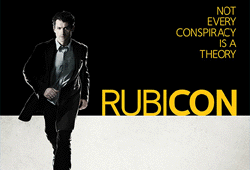
advertisements for Rubicon include the tagline, “Not
every conspiracy is a theory,” a statement that no doubt resonates
with the generation that experienced such traumatic historical events
as the assassinations of John F. Kennedy, Martin Luther King Jr. and
Robert F. Kennedy, as well as the Watergate scandal. Conspiracy theories
abounded during the 1970s, a time period when such paranoia was justified.
The Twenty First Century, meanwhile, is a more grounded time period
and the emergence of the World Wide Web as an outlet for news and information
has certainly limited the potential for conspiracies and cover ups.
In addition, the role of the media to simply report the news changed
after Watergate when two unknown journalists working for the Washington
Post, Bob Woodward and Carl Bernstein, in effect brought down the
Presidency of Richard Nixon through their dogged effort to unravel the
truth about the break in. Suffice it to say that it is a lot harder
now to keep a secret than it was during the 1970s.
Not that
conspiracies have fallen to the wayside in Hollywood. The FOX drama
24 evolved over its eight seasons from an intense thriller
following CTU Agent Jack Bauer as he faced the twenty-four hour pressure
cooker of thwarting terrorist attacks to a series where the enemy more
often than not emerged as members within the government intent on shaping
their own foreign and domestic policies. Even recent film entries into
the conspiracy genre, such as the Will Smith action flick Enemy
of the State and the Mel Gibson/Julia Roberts Conspiracy Theory,
touched on the prospect of government elements pulling the strings behind
the scenes in order to strong arm their own agendas. All of the above,
however, were of the action variety form of entertainment—with
plenty of bullets, dead bodies and explosions that often overshadowed
the plot and cautionary tale of the narrative.
READ
MORE

The
Rubicon Conspiracy: An Analysis
 When
Rubicon premiered on AMC during the summer of 2010, executive
producer Henry Bromell promised an old-school, 1970s-style conspiracy
thriller along the lines of Three Days of the Condor and The
Parallax View. Those movies differed in regards to contemporary
films of the genre, most notably Will Smith’s Enemy of the
State, in that they were more cerebral in nature and featured slow
burning plots that produced the tension and suspense rather than in-your-face
action. Based
on the finished product, Bromell delivered a television series that
indeed lives up to the expectations. Although
early episodes unfolded at their own pace as intelligence analyst Will
Travers stumbled upon mysteries surrounding the death of father-in-law
David Hadas and put the pieces of a larger conspiracy puzzle together,
the intensity of the drama accelerated once the fully formed picture
crystallized, keeping fans of the series on edge and guessing until
the very end.
When
Rubicon premiered on AMC during the summer of 2010, executive
producer Henry Bromell promised an old-school, 1970s-style conspiracy
thriller along the lines of Three Days of the Condor and The
Parallax View. Those movies differed in regards to contemporary
films of the genre, most notably Will Smith’s Enemy of the
State, in that they were more cerebral in nature and featured slow
burning plots that produced the tension and suspense rather than in-your-face
action. Based
on the finished product, Bromell delivered a television series that
indeed lives up to the expectations. Although
early episodes unfolded at their own pace as intelligence analyst Will
Travers stumbled upon mysteries surrounding the death of father-in-law
David Hadas and put the pieces of a larger conspiracy puzzle together,
the intensity of the drama accelerated once the fully formed picture
crystallized, keeping fans of the series on edge and guessing until
the very end.
The Rubicon
conspiracy actually involved three separate storylines that emerged
in the preliminary stages of the series but in the end intertwined into
one complete tapestry. In addition to Will Travers’ personal inquiry
into the death of David Hadas, there were Katherine Rhumor’s attempts
at making sense out of her husband Tom’s suicide and the investigation
of an al-Quaida terrorist by a Travers-led team of analysts at the American
Policy Institute—the government think tank where both he and Hadas
worked. Those three seemingly unrelated narratives all tied back to
a cabal of rich and powerful men who grew up together on Fishers Island,
New York. In classic conspiracy theory fashion, the group has been influencing
world events for both financial gain and to dictate US foreign policy
for decades.
READ
MORE
Rubicon
and the Art of Intelligence
 Although
the AMC drama Rubicon is a conspiracy thriller along the lines
of such 1970s films as Three Days of the Condor and All
the President’s Men, it also paints a detailed portrait of
the art of intelligence work within its narrative. Will Travers, the
main protagonist of the series, is a team leader at the American Policy
Institute, a think tank government agency that sifts through top secret
reports, clandestine photographs and other items of interest in an attempt
to make rational sense of it all. Thus during a majority of the series,
Travers and colleagues Miles Fiedler, Grant Test and Tanya MacGaffin
spend a considerable amount of time investigating an al-Quaida operative
known as Kateb in order to ascertain the terrorist’s whereabouts.
Although
the AMC drama Rubicon is a conspiracy thriller along the lines
of such 1970s films as Three Days of the Condor and All
the President’s Men, it also paints a detailed portrait of
the art of intelligence work within its narrative. Will Travers, the
main protagonist of the series, is a team leader at the American Policy
Institute, a think tank government agency that sifts through top secret
reports, clandestine photographs and other items of interest in an attempt
to make rational sense of it all. Thus during a majority of the series,
Travers and colleagues Miles Fiedler, Grant Test and Tanya MacGaffin
spend a considerable amount of time investigating an al-Quaida operative
known as Kateb in order to ascertain the terrorist’s whereabouts.
In his
book Securing the State (Columbia University Press, 2010),
former British intelligence officer David Omand offers an evaluation
of current intelligence efforts as well as his personal viewpoints on
how this important governmental function should operate. In simplistic
terms, Omand writes that “good intelligence assessment has explanatory
value in helping deepen real understanding of how a situation has arisen,
the dynamics between the parties and what the motivations of the actors
involved are likely to be.”
Under that
definition, API is a textbook example of intelligence assessment work
at its best. Although other government agencies—such as the military,
CIA and NSA—have their own set of analysts, it is Travers and
his colleagues that are consistently at the forefront in regards to
the Kateb investigation. In the episode “Caught in the Suck,”
for instance, Miles Fiedler and Tanya MacGaffin are commissioned by
the CIA to assist in determining whether a detained al-Quaida operative
has factual information about Kateb. In the episode “Wayward Sons,”
meanwhile, it is API that takes the lead in finding Kateb when it is
discovered that he has entered the United States.
READ
MORE
Rubicon:
'The Outsider' Details the Ins of Intelligence Work
 The
AMC series Rubicon is an old-school espionage drama about a
group of government intelligence experts who wield there way through
stacks of top-secret files to decipher, demystify and distill the information
into useful recommendations for their unseen higher-ups. Will Travers,
the defacto leader after his boss/father-in-law David Hadas dies in
a train accident, lost his family during 9/11 and often appears just
as lost as he meanders his way through both his life and job. He quickly
finds himself, however, secretly investigating what he believes to be
a conspiracy surrounding Hadas’ death in addition to rising to
the forefront of his profession.
The
AMC series Rubicon is an old-school espionage drama about a
group of government intelligence experts who wield there way through
stacks of top-secret files to decipher, demystify and distill the information
into useful recommendations for their unseen higher-ups. Will Travers,
the defacto leader after his boss/father-in-law David Hadas dies in
a train accident, lost his family during 9/11 and often appears just
as lost as he meanders his way through both his life and job. He quickly
finds himself, however, secretly investigating what he believes to be
a conspiracy surrounding Hadas’ death in addition to rising to
the forefront of his profession.
Although
Rubicon often progresses at a very slow, deliberate pace as
Travers attempts to unravel the mystery surrounding him, the show’s
fourth episode, “The Outsider,” momentarily pushes the investigation
to the backburner. In what can be considered a more traditional stand-alone
installment, the episode features two separate but concurrent storylines—Travers
is sent to Washington DC to assist with securing the necessary funds
for their operation while his colleagues back in New York are left to
evaluate information regarding an al-Quaida operative and whether or
not the United States should launch a surgical missile strike at his
supposed location. Through the course of the narrative Rubicon
effectively, and at times brilliantly, illustrates the behind-the-scenes
maneuvering of the unglamorous intelligence analysis profession and
the emotional toll the job has on its practitioners.
In many
ways, Will Travers is the antithesis of a government bureaucrat. He
never wears a suit to the office, for instance, and carries a backpack
over his shoulder instead of the more customary briefcase. His brilliance,
as well as the personal tragedy of 9/11, likewise makes him both quiet
and rather aloof. Still, his positive qualities and demeanor have obviously
made an impression on his superior, Truxton Spangler, and although Travers
involvement during the series of high-level meetings in DC makes him
more of a prop than catalysts, one can’t help but assume he is
being groomed for something bigger. And while Spangler himself initially
appears as a weary and easily distracted government official who has
been at his position for more years than even he can probably remember,
he displays an uncanny ability to play the political game on Capital
Hill nonetheless.
READ
MORE


 Rubicon