ALTERNA-TV.COM
TELEVISION MINISITES:
The
Big Bang Theory
During
an age when the majority of television sitcoms are “dumbed down”
in order to appeal to the widest audience possible, along comes the
CBS comedy, The Big Bang Theory. While neither groundbreaking
nor straying far from a traditional format, the series nonetheless proves
it is possible to be both intelligent and funny. The Big Bang Theory
follows a group of youthful genius scientists who also adhere to the
textbook definition of “geeks.” Led by the egocentric Sheldon
Cooper and nice-guy Leonard Hofstadter, they deal with life, love and
awkward social situation with the help of next-door-neighbor Penny,
the attractive and normal object of Leonard’s affections.
The
Buffy 'Verse
If the
Twenty-First Century is indeed the Third Golden Age of Television, then
in many ways it all started with Joss Whedon and Buffy the Vampire
Slayer. Forget about two hour theatrical films, Whedon proved that
television could offer twenty-two hours (the number of episodes in a
full season) in which to tell its narrative. Buffy was a drama,
but it could also be funnier than any comedy on television. It was an
amalgamation of numerous genres, expertly blended, and television has
never been the same since. The series, along with spin-off show Angel,
contains a rich universe ripe for exploration and while both may no
longer be on television, their stories continue in the form of comic
books and graphic novels. Family, love, friendship and betrayal all
play roles within the narratives, making both Buffy and Angel
a unique and insightful commentary on the meaning of life in a seemingly
meaningless universe.
Castle
In many
ways, the ABC series Castle serves a hybrid of the classic
detective shows of yesteryear and the forensic dramas of the Twenty
First Century. Although the production stylings of Castle have
a contemporary edge, the narratives reflect the character-driven nature
of Columbo and The Rockford Files. Richard Castle,
for instance, is a fun-loving, best-selling crime novelist while Kate
Beckett is a non-nonsense homicide detective. When fate throws them
together in a murder investigation, Castle sets his eyes on Beckett
for writing inspiration and manipulates his way onto her team as an
outside consultant doing research. Add a drama queen mother and wise-beyond-her-years
teenage daughter for the former and a supporting cast of colleagues
for the latter, and Castle has all the ingredients of a modern
day update of old-school storytelling.
Dexter
The Showtime
drama Dexter is not what one would call a “typical”
television show. The series, after all, contains a serial killer as
its main antagonist and not only follows his murderous actions but his
attempts to continually stay one step ahead of the law as well. Then
again, Dexter Morgan is not your typical serial killer—he follows
a rigid code in selecting his victims, who are inevitably murderers
themselves that have escaped justice. While Dexter invokes his own brand
of vigilantism in an attempt to keep the streets of Miami safe, he also
struggles with a childhood trauma that has made him hollow inside and
is the source of his murderous tendencies. Dexter is thus not
merely the story of a serial killer but a psychological study of an
empty human being attempting to fit into a society he finds foreign,
while learning the meaning of love, friendship and family in the process.
In short, Dexter is a character study of anyone struggling
to find their place in what can often be a lonely and unknown world.
Dollhouse
Although
the FOX drama Dollhouse had a rocky twenty-six episode run—including
network interference, a Friday night “death slot,” low viewership
and eventual cancellation—the fourth television endeavor of creator
Joss Whedon still managed to rise above those obstacles to become a
genre-breaking classic in its own right. With a very non-network television
premise—the Dollhouse is an underground organization that programs
people to become anyone (while likewise erasing their original personalities)
and the selling its services to the rich and powerful—Whedon was
able to explore the nature of fantasy, produce an dissertation on identity,
create a first-class conspiracy thriller and provide a cautionary tale
of the dangers of unchecked technological advances.
Falling
Skies
The TNT
drama Falling Skies follows the remaining survivors of an alien
attack that has left mankind decimated. While similarly themed sci-fi
fare either deal with the actual invasion, such as Independence
Day and War of the Worlds, or high-level governmental
conspiracies regarding the aliens, like The X-Files and Dark
Skies, Falling Skies begins months after the enemy has
already taken control of the planet. In this sense the series is not
so much about the aliens as it is the perseverance of human beings.
Such themes as family, faith and finding a way to survive in a world
turned upside-down are often contained within each episode. That is
not to say that Falling Skies does not include its fair share
of action, as firefights between the small handful of refugees and the
alien invaders continually break out during the narrative as well. In
the end, however, Falling Skies is a sci-fi drama that is as
much about the drama as it is the science fiction, much like the best
of its genre.
Firefly
The FOX
drama Firefly has had a most tumultuous history. Originally
envisioned as the network’s replacement for the popular X-Files,
it was instead regulated to a Friday night “death slot”
where its ratings lingered at the bottom of the heap. Episodes, meanwhile,
where shown out of order until the plug was finally pulled on the series
in December 2002. Since then, however, the Joss Whedon creation has
gone on to amass a huge cult following and is often considered to be
amongst the best science fiction television shows despite having only
produced a total of fifteen episodes. Firefly follows a rag-tag
group of space scavengers struggling to make a living on the outer reaches
of the universe while likewise remaining under the radar of the far-reaching
Alliance government. The characters are richly drawn and fleshed out
with shades of morally grey, making Firefly void of true heroes
or villains. It is those characters, however—along with crisp
writing and intelligent narratives—that make the series a true
classic.
Fringe
While the
FOX drama Fringe was initially compared to The X-Files,
it has proven to be a unique exploration of the unexplainable in its
own right. FBI Agent Olivia Dunham is assigned to a special unit that
investigates peculiar phenomenon but whereas The X-Files was
an exploration of paranormal activity bordering on the supernatural,
Fringe is grounded in the exploration of “fringe science”—scientific
inquiry in an established field of study which departs significantly
from mainstream or orthodox theories. Dunham is joined by Walter Bishop,
a former scientist employed by the government who has spent the past
seventeen years in a mental institution, and his estranged-but-likewise-genius
son, Peter. While Fringe may be considered “science fiction,”
its plots of possibilities, and questions of moral responsibilities
in regards to scientific experimentation and research, actually transforms
the series into a cautionary tale for our times.
It's
Always Sunny in Philadelphia
It’s
Always Sunny in Philadelphia is not your traditional television
sitcom. For instance, one won’t find laugh tracks, loveable characters
or even happy endings at the conclusion of an episode. Instead the FX
comedy is populated with unsympathetic characters entwined in very politically
incorrect situations that inevitably turn out badly for those involved.
An early tagline declared the series to be “Seinfeld on acid”
and It’s Always Sunny in Philadelphia certainly ups the
ante in regards to unacceptable antics and taboo narratives. The cast,
meanwhile, consists of four self-centered lowlifes who continually fail
to understand the greater world at large while the paternal Frank Reynolds—portrayed
by the hilarious Danny DeVito—sinks to new lows of debauchery.
It’s Always Sunny in Philadelphia may not be a comedy
for everyone, but with its humorous exploration of the underside of
acceptable behavior it is one of the best sitcoms on television nonetheless.
Justified
The FX
drama Justified follows US Deputy Marshal Raylan Givens and
his efforts to uphold the law in the Eastern Kentucky region in which
he was raised. Givens is not a typical modern day government agent,
however, but a throwback to the classic Marshals of an old western,
replete with cowboy hat and boots, gun holstered to his waist and a
penchant for giving criminals twenty four hours to leave town. Being
reassigned to the Harlan County of his youth, meanwhile, allows for
much soul-searching in regards to the man he has become, especially
with a supporting cast that includes ex-wife Winona, his grifter/thug
father Arlo and such crime-loving families as the Crowders and the Bennetts.
The Kentucky of today may not be the Old West of yesteryear but it is
in need of a law enforcer like Raylan Givens nonetheless—and television
itself is better off with the quirky, literate and well crafted drama
known as Justified.
The
Killing
The AMC
drama The Killing follows a pair of Seattle homicide detectives
as they investigate the murder of teenage girl Rosie Larsen. The series
follows a format in which each episode comprises one day, and is likewise
different than traditional crime shows in that it gives equal time to
the grieving family of the victim as well as a mayoral election campaign
that has, at the very least, a circumstantial connection to the case.
With its dreary atmosphere, slow moving pace and numerous red herrings
that pop up during the investigation, The Killing is neither
perfect nor for everyone. The series is not so much about “Who
Killed Rosie Larsen?” however, as it is about the effects of the
murder on those caught in the aftermath. The Killing thus peels
away the outer masks of its characters to reveal the secrets inside,
the demons that haunt and the struggles within. Nothing is ever what
it seems on The Killing—and that’s not necessarily
a bad thing.
Leverage
The TNT
drama Leverage centers on a group of former thieves who now
bring down corporate criminals in an effort to assist victims left with
little legal recourse. Taking a cue from the 1960s series Mission:
Impossible, the group on Leverage—which consists
of hitter (Eliot Spencer), hacker (Alec Hardison), grifter (Sophie Devereaux),
thief (Parker) and mastermind (Nathan Ford)—launch elaborate cons
and subterfuge to recoup the financial losses of their clients and bring
the guilty parties to justice. The “operating outside of the law”
element, meanwhile, conjures memories of the 1980s drama The A-Team.
Leverage is also a product of the Twenty First Century as it
is not the Cold War environment of Mission: Impossible or the
post-Vietnam focus of The A-Team which inspires it narratives
but the inherent imbalances between the “rich and powerful”
and everyday Americans. The series is also entertaining, rewarding and
highly addictive television viewing in its own right.
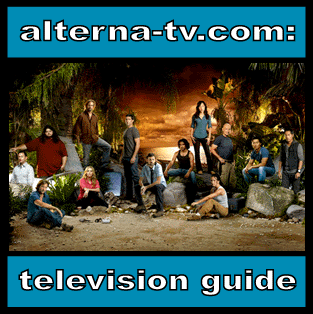
Lost
In many
ways, the ABC drama Lost acts as a metaphor about the life
and struggles of every man (or woman) but taken to an epic level. Religious
and philosophical analogies abound as the purpose of our very existence
is argued on an island void of morals and reason. This debate is most
strikingly personified by the characters of John Locke and Jack Shephard,
one a man of faith, the other of science. But the central question of
whether we have a free will capable of choosing the paths we take, or
if our actions are pre-destined and outside of our control, plays out
in the lives of every character, from Kate Austen to Charlie Pace to
Desmond Hume. Suffice it to say that Lost is not always easy
entertainment, but it is intelligent and meaningful on a variety of
levels.
Mad
Men
Television
is often more than just about entertainment. The ABC drama Lost,
for instance, had a philosophical undertone that challenged viewers
to consider the meaning of their own lives. Sitcoms like The Office
and It’s Always Sunny in Philadelphia, on the other hand,
serve as comedic commentaries on both culture and society. Then there’s
the AMC classic Mad Men. Set during a time period in the not-so-distant
of a past to be relatable but just enough long ago to feel nostalgic,
the series has a sense of intelligence and style seldom depicted on
television. Through the lives of the characters, Mad Men offers
a bird’s eye view of one of the most tumultuous eras in the nation’s
history, one that inevitably shaped modern day society, while the show
itself serves as a reflection of “then” as much as it does
now. Mad Men is intelligent entertainment in a class of its
own, and a commentary on current society as seen through the prism of
the past.
The
Office
Corporate
America serves as the brunt of the jokes and hijinks on the NBC comedy
The Office. An adaptation of the classic British series of
the same name, the American version set itself apart from, as well as
proved to be an equal to, the original due to its remarkable casting
ability. From Steve Carell to Rainn Wilson, Jenna Fischer to John Krasinski,
and even extending to the supporting roles of Angela Kinsey and Creed
Bratton (guitarist for the 1960s rock group the Grass Roots), The
Office has an ensemble cast on par with any ever assembled on network
television. The characters they portray can be identified by anyone
who has ever worked in an office setting, while the weekly plots—although
extreme and exaggerated—likewise resonate. The Office
is a spot-on satire of the struggles the majority of Americans face
while trying to make a living in a white-collar work environment.
Rubicon
The AMC
drama Rubicon is a conspiracy thriller that is more cerebral
than action-packed. Early episodes unwind at their own deliberate pace
as intelligence analyst Will Travers discovers that something is amiss
at the government agency where he works and struggles to put the pieces
of the puzzle together. The series also presents a realistic look at
government intelligence work and the difficulties of deciphering the
end game of seemingly unrelated events. Rubicon is thus a masterful
combination of connect-the-dots mystery and cat-and-mouse suspense,
with in depth characters that bring the narrative to life in a believable
fashion. Viewers expecting a roller coaster action piece featuring guns
a-blazing may be disappointed, but Rubicon’s smart and
savvy stylings make the series gripping nonetheless and raise the level
of intelligent, quality television to even greater heights.
White
Collar
Neal Caffrey
is a smooth conman, expert forger and master thief with a penchant for
Rat Pack-era stylings and an appreciation for wine and art. Peter Burke,
meanwhile, is a down to earth FBI agent with a suburban townhouse who
enjoys cold beer and watching basketball. In the USA Network drama White
Collar, these two polar extremes team up to solve crimes in New
York City. Not only does this partnership prove effective but the series
itself has evolved from its simple concept into quality entertainment.
While part of the reason is the genuine charm of the two main leads,
a fair amount of the credit likewise goes to the strong supporting cast
of the series that includes Caffrey’s former cohort Mozzie and
Burke’s supportive wife Elizabeth. Combining standalone episodes
with enjoyable twists and an overarching narrative involving Neal Caffrey’s
past, White Collar is both an old style television series and
modern day classic.


 Television
Guide
Television
Guide